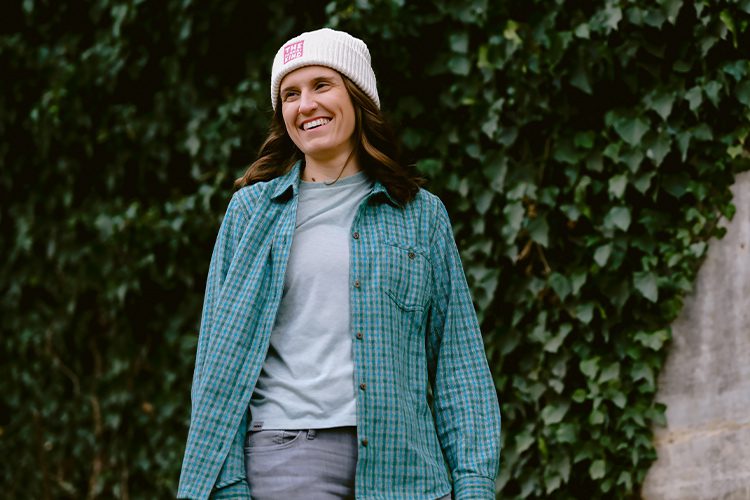
Aimee Kohler started running in 2019 for the same reason many people start running: to lose weight. It’s been seven years since she first laced up at age 23, and the weight-loss goal has become merely a blip on a journey across thousands of miles and thousands of feet of elevation.
Today, Kohler, 30, is the founder and race director for The Running Kind, an event company that focuses on sustainability in trail running, including hosting carbon-neutral races. Cliff’s Notes: Carbon-neutral means Kohler and her team offset the carbon—which plays a critical role in causing climate change—their races produce.
But—record scratch—you’re probably wondering how Kohler got here, leading her own trail-running company. In an effort to motivate herself when she started running, Kohler signed up for a Spartan race. You know the one: an obstacle course race with notes of military boot camp and many shirtless men. In love with the atmosphere, Kohler started working for the company, putting on its events.
In typical runners-meeting-runners fashion, at the encouragement of a new friend, Kohler started mountain and trail running.
“As I left Spartan behind, I was learning about other competitive mountain running events,” Kohler says. “This is what I enjoy. I never liked the obstacles [of the Spartan race], but I liked the trail aspect of it. I didn’t have to be fast. I had to be gritty, which I was good at.”
Kohler, of Nazareth, locked into the trail and mountain running scene. She ran her first race—a 5K—at Blue Mountain. It was maybe forty people, a stark contrast from the thousands of athletes at Spartan events. “You didn’t know who was to the left or right of you,” she says of the large races.
Kohler started working for Blue Mountain, taking over the 5K series, and focusing on her own racing. She tested her competitive chops at Loon Mountain in New Hampshire and the Whiteface Mountain Vertical K in New York (about 3,000 feet of climbing over about three miles).
“I was hooked on the mountains, and my journey quickly escalated from running to lose weight to thinking, ‘I could be good at this,’ if I learned how to train properly,” Kohler says.

During this time, Kohler, disheartened by the waste at corporate racing events, became a vegan athlete and wanted to make a mark—or rather, leave no trace—in the trail-running world. She didn’t understand why running events had to be so wasteful—paper bib numbers, plastic water cups, cheaply made finisher medals and swag bags with shirts.
“I wanted to put races on my own way,” Kohler says. “I was becoming more passionate about being a vegan as well as the carbon footprint races were having.” She attended the US Trail Running Conference and met a woman who worked with a company that sells carbon offsets (a way to compensate for the carbon you generate).
“It didn’t seem that hard to make a carbon-neutral race,” Kohler says, admitting now that it wasn’t as easy as she’d assumed, but it’s not impossible. She worked with Blue Mountain to offset emissions from racers’ transportation to and from their events, which was promising.
Kohler knew she could do this on her own, and if she started her own organization, she could host trail races all over the area.
“It was crazy to me that no one was really doing this,” Kohler says of making trail races carbon-neutral. “In the trail world, that seems so obvious… Trail runners see the impact of climate change. The door was open and no one was going through it.”
So, in 2022, Kohler launched The Running Kind. She hosted her first trail race that fall, the Long Run, at Jacobsburg Environmental Education Center, for which runners have three or six hours to cover a 5-mile loop as many times as they can. Working with Native Energy, Kohler established the Long Run as a carbon-neutral race. It was a fairly small event, about 80 runners (permits issued by state and land organizations prohibit more than 100 registered runners).

A year later, The Running Kind had hosted four events. Kohler acknowledges she and her tiny team—her parents and sibling—may have bitten off more than they could chew. (“When you come to a Running Kind event, Dad is telling you where to park, Mom is giving you your bib, my sibling, Em, is taking pictures on the course.”)
But the organizers were hooked, and so, it seems, was the trail-running community.
In 2026, The Running Kind will host six events: C’mon Armageddon, a 50-kilometer loop in New Jersey (with 5-mile and 10-mile options); Climb It for Climate in the Catskills (25 kilometers with an 8-kilometer option); two versions of the Long Run (a “spring forward” race and the “fall back” race, which will run the loop in reverse); and, new this year, the Little Bitty Backyard (every hour the clock will start for a 3.4-mile mountain loop; runners who fail to start their next loop at the top of the hour are disqualified; the race continues until only one runner remains). During the Backyard, The Running Kind is bringing back Blackout: a night loop of the Little Bitty Backyard.
Though the events are small—trail races are much smaller than their road-race counterparts anyway—Kohler and her team aim to make a big impact when it comes to the runner experience and sustainability education. Unlike most races, particularly road races, The Running Kind events don’t have swag, like cheap tech shirts or T-shirts, or medals. Instead, her team of four collects bottlecaps, paints them and brands them into pins.
“I don’t think we’ll ever have swag,” Kohler says, noting they do have limited merchandise for purchase, all from sustainable brands. “I was nervous
about [not having medals or shirts] at first. People are so used to that. We have handcrafted bottlecap pins, by yours truly.”
On the course, Kohler makes sure her fueling stations are vegan, and the race bibs? They’re reusable cloth. At the end of the race, runners return them, and they’re washed and ready to go for the next event.
“These are tangible things people can think of when they think about The Running Kind,” Kohler says.
The growth of The Running Kind has snowballed, Kohler says. The organization is finally making money, but “I haven’t paid myself yet,” Kohler says. She works at Aardvark Sports Shop and does much of the store’s brand management, design and social media. And last fall she partnered with Mad Catter Coffee Roasters, which works with local farms, to create a specialty roast: The Running Kind Grind.
She purchased a solar generator in 2025, which will count toward certain sustainability certification requirements. “Even though we’ll never be inherently carbon neutral—you’ll have to offset things like travel—our progress is in the right direction,” Kohler says.

Without the support of The Running Kind athletes—walkers, runners, hikers—or the local community, including Aardvark Sports Shop, Emmaus Run Inn and, of course, the trails that host Kohler’s events, The Running Kind wouldn’t be where it is today, Kohler says.
She’s excited about expanding access to her races with hiking options and shorter loops, for example. Kohler laughs: “Mountain running is really just hiking and then sending it downhill.”
“Everyone has been so supportive,” she says. “Now, how do we continue to expand and build community and bring in more people?”
Published as “Insight” in the April 2026 edition of Lehigh Valley Style magazine.