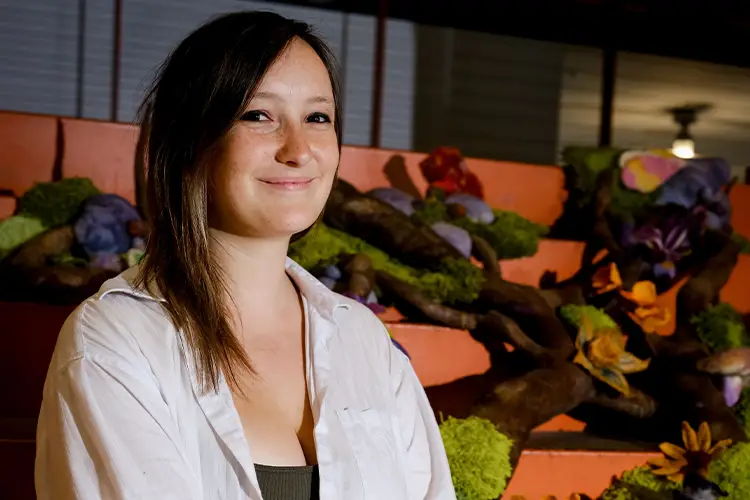
A festival that’s been on the Lehigh Valley’s summer calendar for more than 40 years doesn’t have a lot of firsts yet to achieve. First one-million-attendee year, first fried Oreo (or Twinkie or pickle or mac and cheese), first comedian on the main stage—it’s all been done. And yet, Musikfest racked up a notable never-happened-before when it enlisted artist Mallory Zondag to work her magic on the 2025 poster. Zondag’s creation represents the first time the fiber arts have been given their time to shine on what has become the visual embodiment of the fest that out-fests them all in Bethlehem.
In selecting Zondag, who is 31 years old, ArtsQuest once again leaned on its very creative inner circle; Zondag, a mixed media artist who specializes in fiber felting, grew up in Bethlehem and took a number of classes at the Banana Factory in her youth. She’s been a teaching and exhibiting artist with ArtsQuest since 2017.
During those early years in the Christmas City, when adults posed that question so commonly asked of children (“What do you want to be when you grow up?”), Zondag never faltered. “‘Artist’ was always the first thing that I said, and then it varied what type of art I wanted to do over the years,” she recalls. “A painter, a sculptor, a glassblower, all the variations, but I always wanted to be an artist.”
It helped that her parents were both creative in their own ways, Zondag says. She recalls her mother, Sharon, making elaborate scrapbooks for her and her older sister, Marissa. Her father, Ed, worked as an engineer and had a knack for figuring out how things worked. “So I feel like I have both of those aspects in me, and then I took it in a weirder direction,” Zondag says, laughing.

Perhaps more important than the genes they passed on to their daughter, though, was the way Ed and Sharon Zondag nurtured their budding artist. Besides signing her up for those Banana Factory classes, they sought out people like Deb Berkner, a tailor in Bethlehem, who helped Zondag master stitching and sewing when she began to show an interest in fiber art.
Following her graduation from Moravian Academy, Zondag decided to study fashion design at the Pratt Institute in Brooklyn, New York. That was after an eye-opening trip to the Metropolitan Museum of Art, where, as a teenager in 2011, she visited the Savage Beauty exhibit, a posthumous retrospective of the work of designer Alexander McQueen. “That’s what showed me that textile and fashion and art were all one thing,” Zondag says. “You can make sculpture for the body. You can work in razor clam shells and wood and glass and ceramic and fabric all at the same time and put it on a body. I was like, ‘Okay, that’s what I want to do.’”
Post-Pratt, she was back in the Lehigh Valley and planning her next move, taking on teaching gigs, paint-and-sips, summer camps, studio assistant roles and the like; anything to get her closer to becoming a professional working artist. By that time, she had figured out that, while she appreciated fashion as an art form, she didn’t want to be in the fashion industry. A prior internship with the New York-based artists and brothers Steven and William Ladd, known for their large communal pieces, inspired her to try something similar here.
The Fiber Living Wall program invites students to work together to make a felted wall that looks like something lifted from a lush garden in a fairy tale. She’s partnered with a number of Lehigh Valley schools and organizations over the past few years, teaching them the art of wet felting to create these three-dimensional pieces made of wool. “I love explaining a process to someone, watching it click with them and seeing how they take what I’m teaching and maybe create a brand-new thing that I wouldn’t have thought of,” says Zondag.

While she finds collaboration fulfilling, she sometimes craves solitude, too. Inspiration for her solo pieces comes largely from the natural world and humankind’s relationship to it, for better and for worse, “especially the time that we’re in with the challenge of climate change and the challenge of losing [animal] species, environmental degradation. This is a really anthropocene time,” Zondag says.
For those who view her work, she hopes simply for an emotional reaction. “If they look at my work and feel absolutely nothing, I don’t think I’ve done my job right,” Zondag says. “I create my art for me because I feel like I have to express myself in this way. There’s no other option. I feel that I have to be an artist. It’s how my mind works. It’s how my hands work. But for people to come and see my work, if they have an experience in viewing it, that is the most important part to me.”
Bringing one of her pieces to life requires preparation and planning, peeling back the layers of the structure she can see in her mind. She credits her father’s engineering acumen with guiding her through that part of the process. But it doesn’t always work out, Zondag says. “Especially with a lot of the wet felting, when you’re working with wool and water and you’re trying to sculpt it, sometimes the material will be like, ‘Nope, I don’t want to do that, I’m going to do
this instead.’”
She has exhibited widely in the Lehigh Valley, with shows at the Banana Factory, the Allentown Art Museum and Muhlenberg College’s Baker Center, among others, but her reach extends well beyond her old stomping grounds—shows in New York City; New Orleans; Berkeley, California; and even as far away as Ukraine pepper her curriculum vitae.

Zondag also has been an artist-in-residence at Acadia National Park, the Wassaic Project in Wassaic, New York, and the Allentown Art Museum, where she led workshops and created the installation Cocooned in 2020, as the museum was coming out of its own cocoon after being shuttered by the COVID-19 pandemic.
One of Zondag’s crowning achievements as an artist came in 2022, when she was commissioned by the artist Amalia Mesa-Bains to craft a large moss rug for one of her installations at the Whitney Museum of Art in New York City. The rug, which was created entirely by hand and took over 600 hours to make, is now part of the museum’s permanent collection.
Zondag now lives in Schenectady, New York, but she returns to the Lehigh Valley often for school and community programs, to teach workshops, to show her work and to visit her parents and sister. “I’ve stayed pretty well connected to the area because it is a wonderful, wonderful place,” she says.
A return trip is already planned for early August, when Musikfest 2025 will be in full bloom. The poster Zondag designed for the festival shows Bethlehem’s north and south sides connected through an underground, intertwined root system. Among those roots are music staffs, representing the unifying power of music and Musikfest: 10 days of community connection under the summer sun in the Christmas City.
Zoom out, and the same themes apply to how Zondag views the arts in general. “Arts and music and creative expression is a way for us to share our stories with each other,” she says. “And that’s how we connect and create a strong, stable community.”

Published as “Insight” in the July 2025 edition of Lehigh Valley Style magazine.