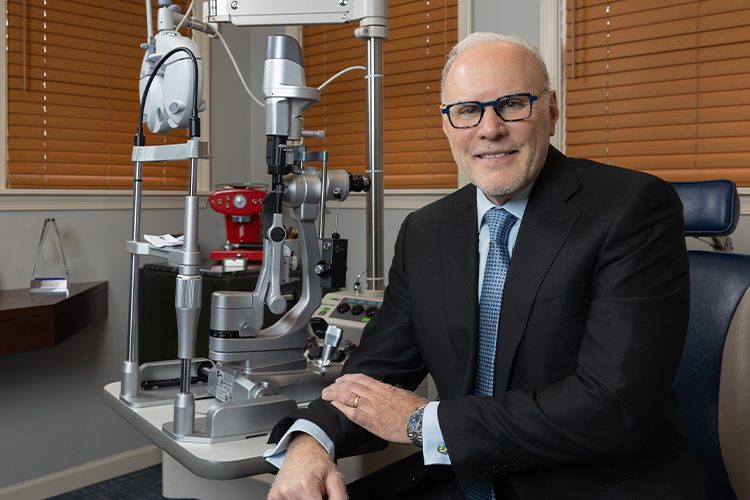
Dry eye is on the rise, a persistent, uncomfortable condition that’s difficult to treat and accelerated by our screen-focused lifestyles. Easton optometrist Dr. John P. Boscia explains how dry eye has bedeviled him and his patients for decades, and the promising new therapies that are giving relief.
What’s Going Wrong
Each time we blink, our eyes deposit a three-layered tear film. Ideally, this film maintains stability for at least ten seconds, carrying our eyes juicily through the day. The layer closest to the eye is a mucin layer that adheres to the surface, the next is a layer of aqueous tears and the outer layer is an oil produced by tiny meibomian glands along the eyelid.
Atrophy of the meibomian glands is one of the main causes of dry eye. When that protective oil is lacking, the eye’s film breaks down too quickly. “We have great technology that allows us to time the breakdown of the film after a blink to the tenth of a second,” Boscia says. This, along with a magnified inspection of the glands, can diagnose an eye that can’t keep itself wet.
Who’s Affected
The largest demographic to be affected is post-menopausal women, due to drying hormonal shifts. People with rosacea also find that dry eye can be a side effect of vascular inflammation occurring near the eyelids. However, the scourge of screens has caught us all in its net.
Folks with lifestyles that have them staring at a computer screen in an office full of forced air are on the road to dry eye, and a growing number of young people are coming into Boscia’s office with their glands looking limp as each new generation exceeds the previous record for screen time.
“We see teens with glands that are already terribly compromised,” Boscia says. “Parents tell us their kids are gaming constantly. It’s not just older people or menopausal women who are affected.”
Prevention
Before any sandy, itchy feeling steals over us, we need to make moisture a priority. “We’re ideally blinking fifteen times a minute,” Boscia says, which refreshes the film and physically pumps the glands producing it. “With all the screen time, we’re only blinking five.”
When life requires hours staring at the computer screen (or doomscrolling), Boscia recommends laying in eyedrops and instilling them every hour, before symptoms of dryness develop. The 20-20-20 rule is also still relevant: every twenty minutes, look at something twenty feet away for twenty seconds. This helps eye muscles and moisture stay limber and lush. Be mindful of whether your medication (like those for allergies or glaucoma) is adding risk of aridity, and Boscia recommends waterproof makeup that won’t melt into your eyes. Anything that causes inflammation to the eye threatens the stability of continuing gland health.
Inflammation & Intervention
Other factors outside our control can lead to the inflammation that kicks off this condition, from aging to an infestation of the demodex mites that populate our eyelashes. And once the cornea is bruised by irritation or the glands are giving up, that inflammation reinforces itself. Most treatments available have been short-term, applying to symptoms and not the cause. “Over the years, we’ve been very frustrated with what we’ve been able to accomplish,” Boscia says.
Depending on the causes of dry eye and how exhausted a patient’s meibomian glands have become, various medications and therapies can help. Eye drops and gels keep the eye comfortable in the short term, while dissolvable tear duct plugs slow tears from draining off the eyes. Treating irritating conditions like demodex blepharitis and damage to the cornea also offers some alleviation. Amniotic membrane therapy applies stem cells directly to the eye to help repair its surface. But for serious cases needing long-term relief, Boscia brings out the big guns.
The OptiLight Option
The treatment that has given Boscia and his patients the most cause for relieved celebration is a newer one: intense pulsed light (IPL) therapy, in the form of the FDA-approved OptiLight device. IPL is commonly used in dermatology, where it was discovered that treatment close to the eye also relieved dry eye symptoms. “The light penetrates beneath the skin to affect the root causes of inflammation,” Boscia says, “and the glands can resume function.”
This is all but unheard of in the world of dry eye, so three-ply tears of joy are being shed. Here’s how a session works: a patient reclines as if for a spa treatment with shields over the eyes, ultrasonic gel is applied and ten minutes later the precisely applied light has made its pass non-invasively over the margins of the eyes. The typical schedule is three to four sessions, two to four weeks apart, and in that time, Boscia says, “We start to see the oil coming back.”
Patients have reported relief lasting at least six months, and hopefully as long as a year.
Published as “Ask the Expert” in the April 2026 edition of Lehigh Valley Style magazine.